Recently, Dr Kashif Naseem from the School of Materials and Environmental Engineering at Hunan University of Humanities, Science and Technology (HUHST) published a research article in Renewable Energy, a top-tier journal in engineering and technology (CAS Zone 1; impact factor: 9.1). The article is entitled “The catalytic role of cubic iron oxide coated graphene oxide for hydrogen generation via hydrolysis of Magnesium” (Chinese title: “立方状Fe2O3修饰氧化石墨烯复合材料(Fe2O3@GO)助力镁的水解制氢”). HUHST is listed as the first affiliated institution, and Dr Kashif Naseem is the first author.
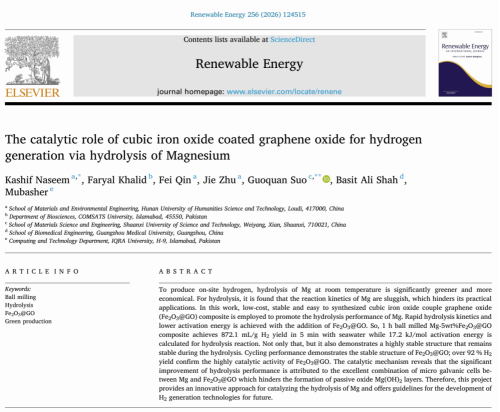
Hydrogen energy, as a promising clean energy source, is an important pathway to achieving the dual goals of carbon peaking and carbon neutrality. Magnesium is considered an attractive material for hydrogen generation via hydrolysis due to its abundant raw materials, low cost, and environmental friendliness, yet its slow hydrogen generation rate has hindered large-scale practical application. In this study, a low-cost, stable, and easily synthesized cubic Fe₂O₃-modified graphene oxide composite (Fe₂O₃@GO) was employed to enhance the hydrogen generation performance of magnesium via hydrolysis. When Fe₂O₃@GO was mixed with metallic magnesium at a mass ratio of 5% and subjected to ball milling for 1 hour, a hydrogen yield of 872.1 mL/g in seawater was achieved within 5 minutes. The reaction mechanism shows that the remarkable enhancement in hydrogen generation can be attributed to the formation of numerous micro-galvanic cells between magnesium and Fe₂O₃@GO, which effectively suppress the formation of the passivating Mg(OH)₂ layer. This work proposes an innovative approach to catalytic hydrogen generation via magnesium hydrolysis and provides valuable insights for developing greener hydrogen production technologies.
Article link: https://doi.org/10.1016/j.renene.2025.124515
(Text/Photos: Yang Xianglin; First review: Yang Xianglin; Second review: Peng Weicai; Final review: Wen Jin)