From June 20 to 22, 2025, 2025 IEEE 3rd International Conference on Pattern Recognition, Machine Vision and Artificial Intelligence (IEEE PRMVAI 2025) was held at Hunan University of Humanities, Science and Technology (HUHST). The conference was jointly hosted by the IEEE China Council and HUHST, with strong support from Nanjing University of Aeronautics and Astronautics, Shandong Women’s University, ELS Publishing, ESBK International Academic Exchange Center, the Academic Center, and other universities and academic institutions. The event brought together more than 100 renowned experts and scholars from over ten universities and research institutes at home and abroad.

The conference covered a wide range of disciplines related to pattern recognition, machine vision and artificial intelligence, featuring one keynote speech, four invited talks, and many oral presentations in parallel sessions. Prof. Zhu Qiang, Deputy Secretary of the CPC HUHST Committee, delivered the opening speech.
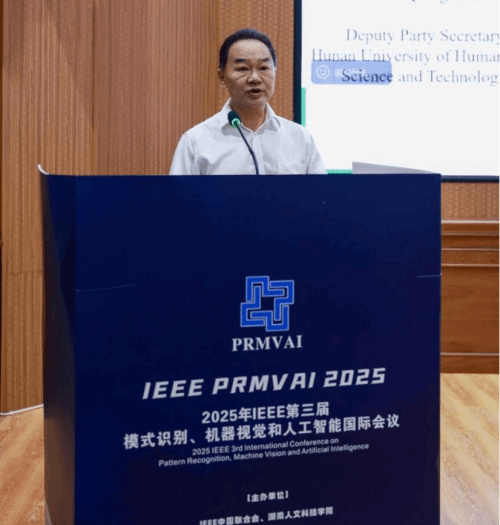
Prof. Zhu Qiang Delivers the Opening Speech
Prof. Chen Zhigang from Central South University, recipient of the State Council Special Government Allowance and a National Teaching Master, delivered the welcome speech.
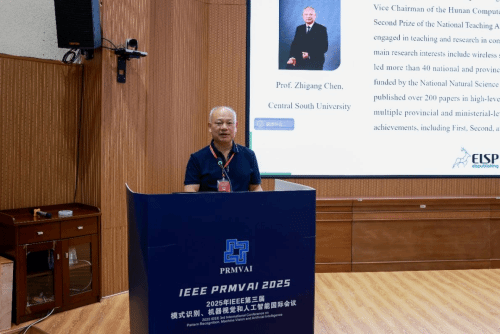
Prof. Chen Zhigang Delivers the Welcome Speech
Assoc. Prof. Ren Ju of Tsinghua University, a recipient of the National Science Fund for Excellent Young Scholars and a Changjiang Scholar, addressed the high computational overhead and user privacy risks of existing cloud-based deployment paradigms. He proposed OmniMind, an on-device intelligent agent architecture, and focused on the core technical challenges and corresponding solutions.

Assoc. Prof. Ren Ju Delivers the Keynote Speech
Assoc. Prof. Dai Haipeng of Nanjing University, a Young Changjiang Scholar, presented an optimization scheme for AI-empowered video analysis systems. By introducing deep reinforcement learning and deep neural network algorithms and leveraging the spatio-temporal similarity of video streams, his work effectively reduces latency and computational costs in video processing.
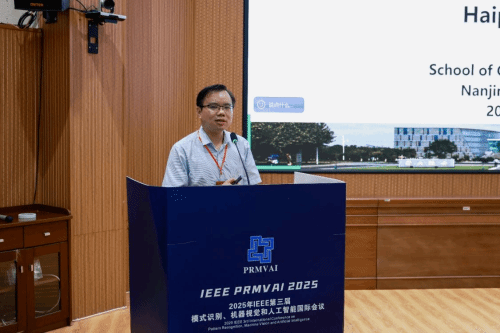
Assoc. Prof. Dai Haipeng Gives an Invited Talk
Assoc. Prof. Chen Xie from Shanghai Jiao Tong University introduced F5-TTS, an open-source, high-quality speech synthesis model. Building on Microsoft’s E2-TTS, the model optimizes the architecture by integrating DiT and ConvNeXt V2 and is trained on large-scale speech datasets, thereby improving the fidelity and expressiveness of speech synthesis.

Assoc. Prof. Chen Xie Gives an Invited Talk
Prof. Liu Jun of Lancaster University, listed among the world’s Top 2% Scientists, has carried out a series of studies on human modeling and behavior analysis, covering human action recognition, pose estimation, motion analysis, and digital human generation. He presented important self-constructed datasets such as NTU RGB+D and UAV-Human, as well as key algorithmic models including Spatio-Temporal LSTM and DiffPose, and discussed their practical value in scenarios such as robotics, health monitoring, and the metaverse.
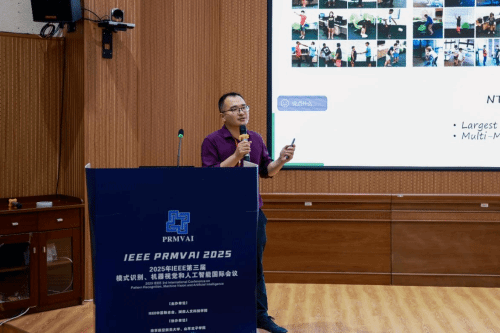
Prof. Liu Jun Gives an Invited Talk
In the afternoon parallel sessions, participants engaged in in-depth discussions on topics related to pattern recognition, machine vision and artificial intelligence. Dr. Peng Zili, from the School of Information of HUHST, made a presentation entitled “Light-VM2D-UNet: A Lightweight UNet Enhanced with Mamba2D for Medical Image Segmentation”. Starting from the challenges faced in medical image segmentation, he systematically introduced the Light-VM2D-UNet solution proposed by his research team, analyzed the limitations of existing approaches, and elaborated on their innovative PVM2DRes module. By integrating a 2D wavefront scanning mechanism with local context enhancement, the module addresses the spatial bias and poor detail preservation of existing Mamba-based models in medical image segmentation. He also presented experimental results on three benchmark datasets. The attending scholars had lively discussions about the strengths of the model and its future development, and agreed that this work provides an efficient solution for medical image segmentation in resource-constrained environments.
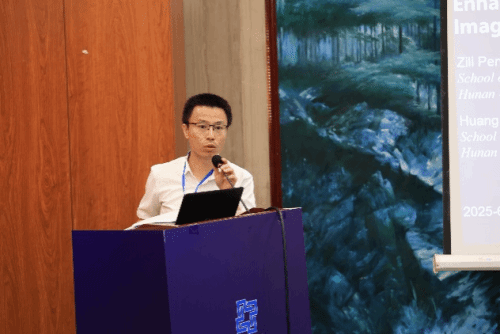
Dr. Peng Zili Makes a Presentation
In recent years, the School of Information has remained firmly committed to the fundamental mission of fostering virtue through education and to the goal of cultivating high-caliber, application-oriented talents. Benchmarking its programmes against engineering education accreditation standards, the School of Information has deepened university–enterprise cooperation through the integration of industry and education, embedded the holistic view of national security throughout the entire education process, and focused on cultivating advanced computing talents in innovative applications of information technology. By building specialized platforms to serve local industries and innovating models of university–enterprise collaboration, it has achieved improvements in both graduate employment quality and discipline development. It has established an IT talent training system that integrates academic competitions with innovation and links industry with education, thereby creating a multi-dimensional ecosystem where competitions drive innovation, innovation enhances learning, and industry and education reinforce each other.
The faculty team closely follows cutting-edge research frontiers and has formed several research and innovation teams in areas such as networks and computational intelligence, artificial intelligence applications, and electronic information science and technology. Team members conduct in-depth research in edge computing, knowledge graphs, causal inference, disease recognition, affective computing, and computational materials science, and have published more than 20 papers in leading journals including IEEE Transactions on Mobile Computing (TMC), IEEE/ACM Transactions on Audio, Speech, and Language Processing (TASLP), Neural Networks, and Neurocomputing. The School of Information currently offers the following majors: Computer Science and Technology (a provincial “14th Five-Year Plan” Distinctive Application-Oriented Discipline), Network Engineering (a national first-class undergraduate programme construction site), Software Engineering (a provincial first-class undergraduate programme construction site), Artificial Intelligence, Electronic Information Engineering (a provincial first-class undergraduate programme construction site), Communication Engineering (a provincial “12th Five-Year Plan” comprehensive reform pilot programme), and Physics.
(Text/Photos by Gong Cheng and Tang Yuxing; First review by Li Weimin; Second review by Zhu Gaofeng; Final review by Xie Silian)